

Upflow → Blog → AR collections
Accounts Receivable Process: Steps & How to Optimize It
Alexandre Antoine
|
August 5, 2026
Generate AI summary


The accounts receivable process is how your business turns completed sales into actual cash. It starts the moment you issue an invoice and ends when the payment is recorded and reconciled. What happens in between: follow-ups, disputes, cash application, reconciliation. That sequence determines how fast, how reliably, and how painlessly you get paid.
For most B2B SaaS finance teams, the process works until it doesn’t. As your customer base scales, the gaps become harder to ignore: invoices go out late, follow-ups are inconsistent, cash application is a mess, and no one has a clean view of what’s actually outstanding. This guide walks through the AR process end to end, the points where things typically break down, and how to fix them. In this guide, you’ll learn:
- What Is the Accounts Receivable Process?
- The Accounts Receivable Process: Step by Step
- Common AR Process Challenges
- How to Optimize Your Accounts Receivable Process
- Key AR Metrics to Track
- When to Automate Your AR Process
Want to see how Upflow handles the AR process end to end? Book a call with one of our experts today.

What Is the Accounts Receivable Process?
Accounts receivable (AR) is money owed to your business by customers who’ve received goods or services but haven’t paid yet. The accounts receivable process is the end-to-end system for managing that money, from issuing invoices to collecting payment, recording and reconciling it accurately.
It sits within the broader order-to-cash cycle, which covers everything from when a customer places an order to when cash hits your account. AR is the back half of that cycle: the part that actually turns revenue into working capital.
In B2B SaaS, this matters a lot as revenue is often recognized before cash is collected. Subscription renewals, expansions, and upsells all run through the same customers your AR team is chasing. Done well, the AR process keeps cash flow predictable, reduces bad debt, and protects customer relationships. Done poorly, it creates collections bottlenecks, cash flow gaps, and the kind of friction that quietly erodes retention.
The Accounts Receivable Process: Step by Step
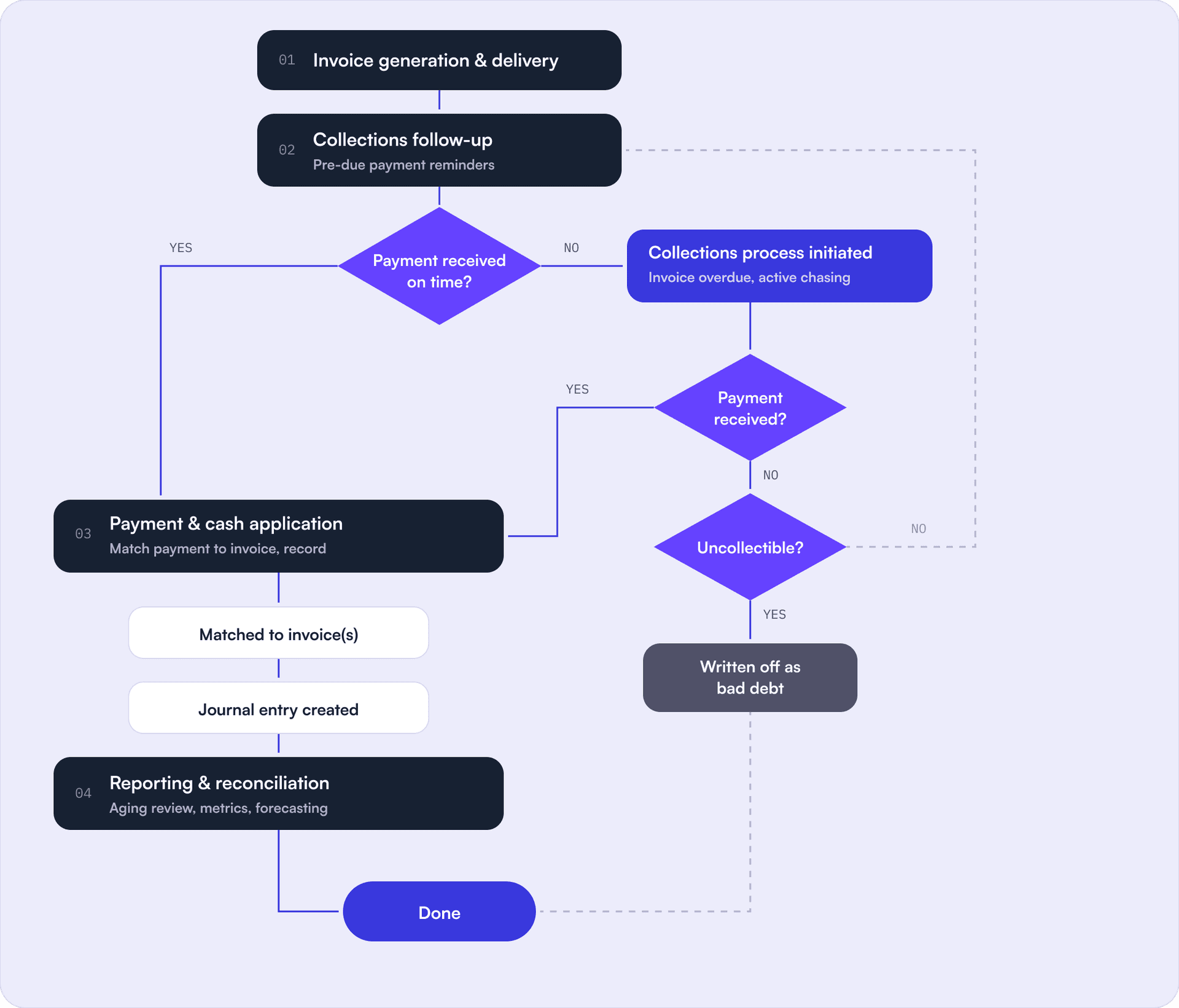
The AR process typically follows a consistent sequence. Here’s how it breaks down, including how the key decision points play out in practice:
1. Invoice generation and delivery: Once a sale is finalized, an invoice is issued with the agreed amount, payment terms, and due date. In SaaS, this usually happens automatically at the point of subscription activation or renewal. The invoice should be accurate and delivered promptly. Delays here directly delay payment. A customer can’t pay an invoice they haven’t received, and disputes almost always start with an invoice they don’t recognize or agree with.
2. Collections follow-up: Once the invoice is out, a few polite payment reminders go out before the due date to make sure it’s on the customer’s radar and there are no issues before payment is due.
3. Payment collection: If payment comes in on time, it moves straight to cash application. If not, the collections process kicks in: structured follow-up and escalating outreach across email, calls, SMS, and in more extreme cases, a formal collection letter.
Most customers will pay. For the ones that don’t, you eventually have to assess whether the invoice is recoverable. If it’s not, it gets written off as bad debt.
4. Payment and cash application: When payment is received, it needs to be matched to the correct open invoice and recorded in your accounting system. At low volumes, this is straightforward. At scale, it becomes one of the more time-consuming parts of the AR process, especially when customers pay multiple invoices in a single transfer or send payments without remittance details. Poor cash application inflates your apparent AR balance and distorts your cash flow picture.
5. Reporting and reconciliation: At the close of a period, your AR team reconciles outstanding balances, reviews the aging report, and ensures all payments are accurately recorded. This is also when AR metrics are reviewed and shared with leadership to inform cash flow forecasting.
Common AR Process Challenges
Understanding the steps is one thing. The harder question is why the process breaks down in practice. Here are the most common failure points for B2B SaaS finance teams:
Slow or inaccurate invoicing: Late invoices delay the entire payment cycle. Inaccurate ones invite disputes that push payment back further. In SaaS, where billing can involve usage-based components, mid-cycle upgrades, or multi-year contracts, invoice accuracy is a recurring problem. Both are often symptoms of a disconnected billing setup, where invoicing isn’t triggered automatically and relies on someone remembering to do it.
Inconsistent follow-up: Without a systematic collections workflow, follow-ups get missed or happen too late. Some customers get chased; others don’t. The result is an unpredictable aging profile where late payments accumulate not because customers can’t pay, but because no one asked.
No visibility into what’s actually outstanding: Many SaaS finance teams don’t have real-time visibility into their receivables. They find out how bad the situation is at month-end, not in time to do anything about it. As our CEO Alex Louisy notes in his 5 maturity stages of cash collection: you can’t improve what you don’t measure, and most B2B companies don’t even know they have a problem.
Cash application backlogs: Matching payments to invoices manually is error-prone and time-consuming. At scale, it creates reconciliation issues and inflates your apparent AR balance with payments that have been received but not yet recorded. For SaaS companies running high invoice volumes, this is one of the first processes that breaks.
Siloed AR data: When AR lives in a spreadsheet or an inbox, context doesn’t travel. Sales doesn’t know a key account is 60 days overdue. Customer success doesn’t know a disputed invoice is blocking renewal. Finance can’t produce a clean cash flow forecast. In SaaS, where those teams are closely interlinked, that siloing is especially costly.
Treating collections as purely transactional: This is the subtler problem. A finance team that sends reminder emails without any customer context, the same template to every account regardless of relationship or history, will collect eventually, but often at the cost of goodwill. In B2B SaaS, where your customers are also your best candidates for renewal and expansion, the way you collect matters as much as whether you collect.
How to Optimize Your Accounts Receivable Process
Optimizing AR isn’t a one-time project. It’s a maturity curve. In our cash collection maturity framework, teams progress through five stages: from no real measurement, through systematic workflows and collaborative collection, toward predictive, data-driven AR management. Here’s how to move up that curve:
Start with measurement: You can’t improve what you don’t track. The baseline is knowing, in real time, which invoices are outstanding and for how long. From there, track your aging report regularly and review your DSO against your standard payment terms. If your DSO is more than 30% above your average payment terms, something in the process is broken. For SaaS teams, also keep an eye on average collection period by customer cohort, since renewal timing often masks collection issues. Not sure where to start? Download our free spreadsheet to calculate your key AR metrics in one place.


Alexandre Antoine
Finance Director at Upflow
Alexandre is the Finance Director at Upflow, where he leads the company’s internal finance and accounting operations. With a background in both strategic finance and financial reporting, Alexandre brings a practical, detail-oriented approach to the complexities of B2B finance.
At Upflow, Alexandre ensures that internal processes from cash management to KPI reporting are optimized for transparency, accuracy, and growth-readiness. He helps build scalable finance systems that support Upflow’s mission to empower other finance teams through better collections and cash flow insights.
Alexandre regularly contributes to Upflow’s blog with in-depth articles on accounting metrics, financial ratios, reporting best practices, and operational benchmarks. His writing provides actionable advice for controllers, FP&A teams, and finance leaders navigating complex financial processes.

Related articles