

Upflow → Blog → Inside Upflow
Upflow MCP Brings AR Data Directly Into Your Favorite AI Tools
Alex Louisy
|
April 24, 2026
Generate AI summary


AI tools like Claude and Copilot are already part of daily workflows for many finance teams. They help write reports, summarize data, and support analysis.
But when it comes to accounts receivable, there has always been a gap.
Your data lives inside tools like Upflow. Your reasoning happens inside AI assistants. Until now, you had to switch between both.
With the launch of the Upflow MCP server, that changes.
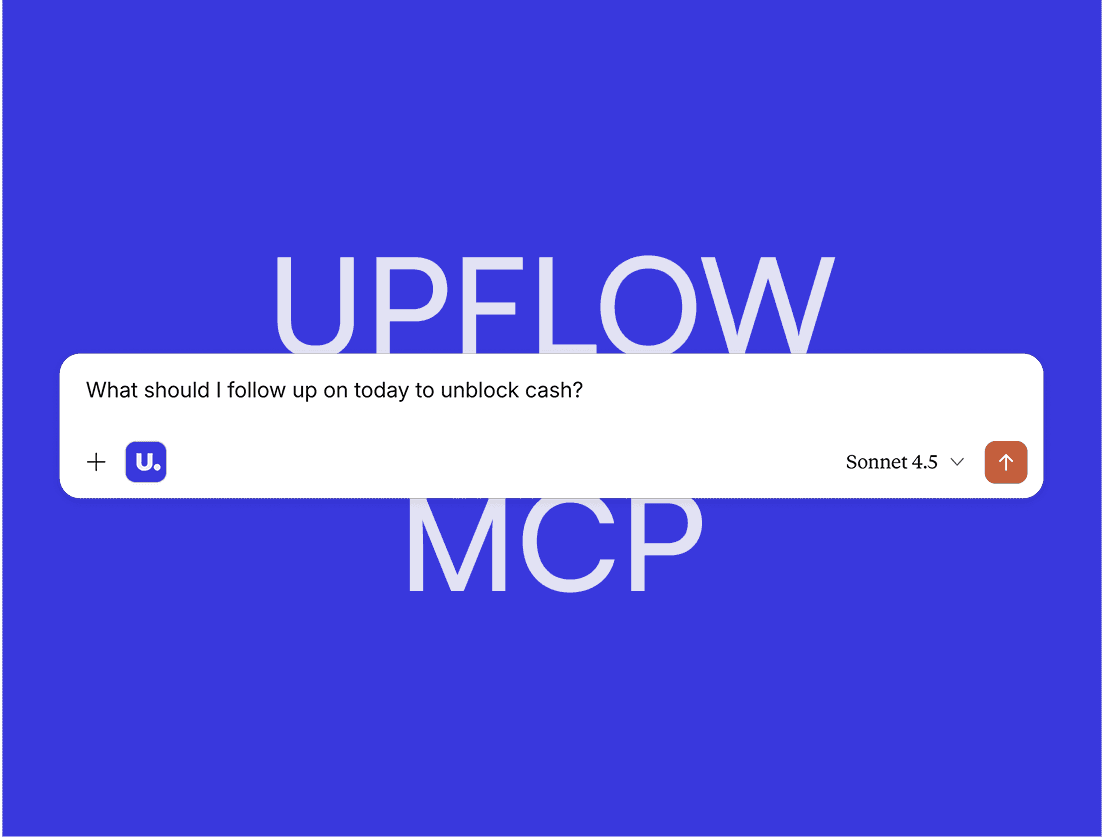
MCP allows AI assistants to securely connect directly to your Upflow data. You can now ask questions in plain English and receive answers grounded in real invoices, real payment behavior, and real customer interactions.
No exports. No manual reports. No context switching.
Just answers.
AI Built the Right Way for Collections
Accounts receivable is not just about automation. It is about relationships.
A poorly timed reminder or an incorrect assumption about a customer can damage trust that took years to build. That is why we have taken a deliberate approach to AI at Upflow.


Alex Louisy
CEO & Co-Founder @ Upflow
Instead of rushing announcements, we focused on building, testing, and iterating in production. MCP builds on that foundation.
Rather than adding another dashboard or feature, MCP turns your existing AI assistant into a gateway to your AR data. It allows teams to interact with their receivables conversationally, while staying grounded in our Financial Relationship Management framework.
FRM is the foundation. AI is the accelerator.
What MCP Unlocks for Finance Teams
Once connected, Claude or Copilot can securely access your Upflow data and answer questions instantly.
Here is what that looks like in practice.
For AR Managers
- Who should I prioritize this week?
- Which accounts represent the highest risk?
- Show me customers with the largest overdue balances.
MCP generates ranked lists based on outstanding amounts, aging, risk signals, and communication history. Priority becomes clear without building a single report.
For Controllers
- What is blocking payment on this account?
- Why are these customers consistently late?
- Are there disputes or missing contacts?
MCP surfaces disputes, broken promises to pay, missing purchase orders, and communication gaps. It summarizes the situation clearly so teams can distinguish between customer-side issues and internal process gaps.
For CFOs
- Give me a cash flow analysis for this week.
- How much can we realistically expect to collect next week?
Instead of relying on due dates alone, MCP adjusts forecasts based on actual historical payment behavior, giving finance leaders a more accurate and actionable cash forecast.
Powered by High-Quality Data
AI only works when the underlying data is reliable.
We at Upflow have spent years building deep native integrations with major ERP and billing systems. We combine structured data such as invoices, payments, and transactions with unstructured information including emails, notes, and full customer timelines.
This unified data layer is what makes MCP powerful.
When an AI assistant responds to a question, it draws from complete financial records and real interaction history. The result is intelligence that is contextual, accurate, and operationally useful.
Without this infrastructure, AI risks becoming noise. With it, AI becomes an extension of your workflow.
Ready to Try Upflow’s MCP?
The Upflow MCP server is now available for all our customers.
If you want to connect Claude or Copilot directly to your AR data and see what becomes possible, contact us to get access now.
The future of accounts receivable is intelligent, contextual, and relationship-driven. And this is just the beginning.

Alex Louisy
Co-founder and CEO of Upflow
Alex is the Co-founder and CEO of Upflow, where he leads the company’s mission to revolutionize how B2B businesses manage their cash flow. Backed by top-tier investors like Hedosophia, YCombinator, Hexa, and Lorimer Ventures, with more than $25m in funding to date, he is a strong advocate for financial transparency and operational excellence, bringing a founder’s perspective to the biggest challenges and opportunities in modern revenue management.
Alex developed Upflow’s widely recognized “5 Maturity Stages of Cash Collection” framework, a model that has helped hundreds of companies build scalable and efficient finance operations. He also co-hosts The Growth-Minded CFO podcast, where he engages with finance and business leaders on innovative approaches to financial leadership. His thought leadership explores the intersection of business strategy, financial discipline, and organizational growth.
As a regular contributor to Upflow’s blog, Alex shares insights on leadership, scaling SaaS businesses, and the future of B2B finance. His writing helps founders, CFOs, and revenue leaders make smarter decisions and build financially resilient companies.
FAQs
Can’t find what you’re looking for?
Ask AI
The Upflow MCP server allows AI assistants like Claude and Copilot to securely connect directly to your Upflow accounts receivable data. It enables finance teams to ask questions in plain English and receive answers grounded in real invoices, payment history, and customer interactions.
MCP is designed to work with leading AI assistants such as Claude and Copilot. Once connected, these tools can securely access your Upflow data to provide contextual insights and forecasts.
Yes. MCP connects AI assistants to Upflow through a controlled and secure architecture. Access is permission-based and aligned with your existing data structure, keeping sensitive financial information protected. Upflow is SOC 2 Type 2 certified, and all financial data is encrypted to enterprise-grade standards.
Traditional dashboards require manual navigation, filtering, and interpretation. MCP allows you to interact with your AR data conversationally. Instead of building reports, you can simply ask questions and receive structured, contextual answers instantly.
Upflow MCP is built for AR managers, controllers, and CFOs who want faster access to reliable insights. Whether prioritizing follow-ups, investigating payment delays, or forecasting collections, this MCP helps teams make better decisions without switching tools.
Related articles