

Upflow → Blog → AR collections
The Guide to Writing Effective SMS Payment Reminder Messages
Quentin Gaudinat
|
October 2, 2025
Generate AI summary


For finance leaders, managing working capital is a constant battle, and late payments are the primary adversary. The scale of this challenge is staggering: over half (56%) of small businesses are owed money from unpaid invoices, averaging $17.5K per business, according to Intuit QuickBooks’ 2025 US Small Business Late Payments Report. Meanwhile, the Federal Reserve’s 2024 Report on Payments reveals that 80% of small firms experience some form of payment-related challenge.
This payment crisis directly translates to liquidity constraints that ripple through every aspect of business operations, from payroll and inventory management to strategic investments and growth opportunities. Traditional dunning emails, while still standard practice, are losing their effectiveness in an era of digital saturation and overflowing inboxes, with the average email open rate across industries reaching 42.35% according to HubSpot’s 2025 benchmarks.
To counter this, leading finance departments are accelerating cash flow and building more resilient accounts receivable processes by adopting a channel that delivers immediate, personal, and overwhelmingly effective results: automated SMS reminders. Keep reading to learn more about:
- The Business Case for SMS Reminders
- Essential SMS Payment Reminder Best Practices
- Proven SMS Payment Reminder Templates
- Legal Considerations and Compliance
- Implementing SMS at Scale
- How Hokodo Accelerated Collections with SMS
Curious to see SMS payment reminders in action? Book a demo and learn how they can speed up collections and reduce late payments.

The Business Case for SMS Reminders
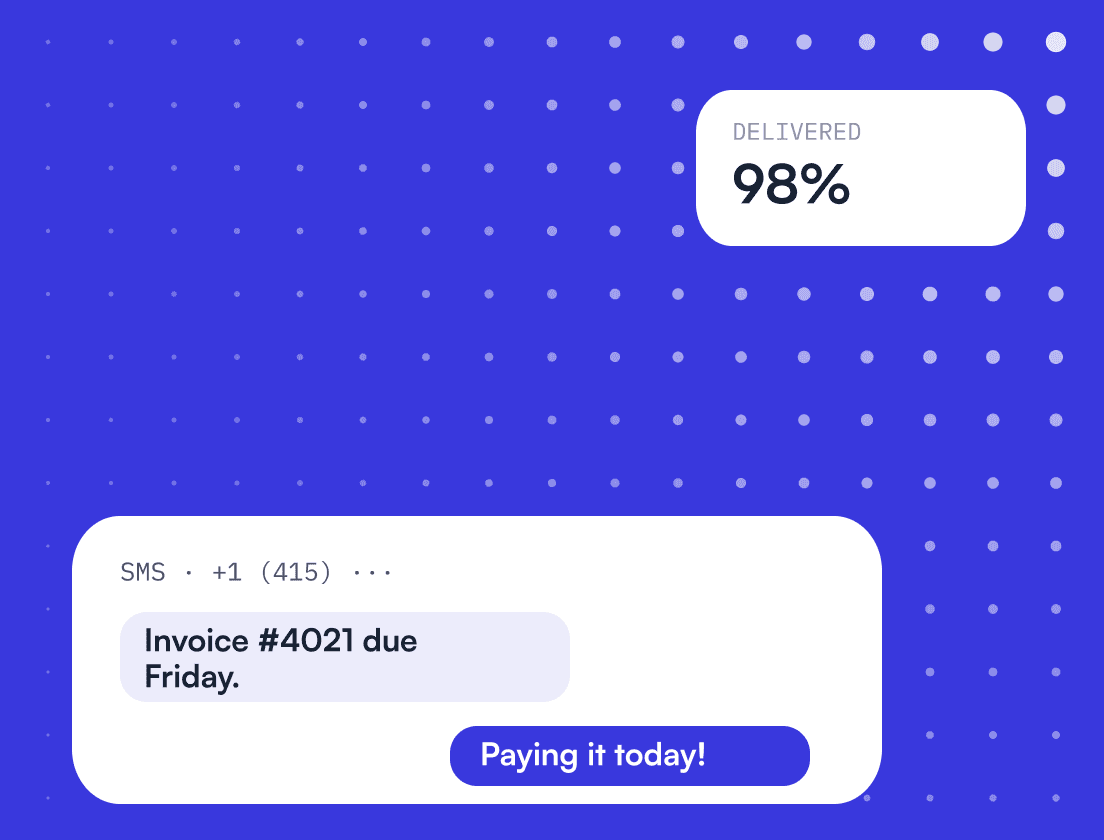
Payment reminder text messages have emerged as one of the most effective channels for accounts receivable teams. The statistics speak for themselves: SMS messages boast an impressive 98% open rate, significantly outperforming email’s average open rate of just 20-25%. Even more compelling, 81% of consumers check their text messages within just five minutes of receiving them, making SMS the ultimate channel for time-sensitive payment communications.
The advantages of incorporating SMS into your payment reminder strategy extend far beyond impressive open rates:
Immediate Impact: With such high open rates and rapid response times, SMS reminders can dramatically reduce the time between sending a reminder and receiving payment.
Cost-Effective: SMS messages are relatively affordable compared to phone calls, printed letters, or more aggressive collection methods. The cost per message is minimal compared to the potential return on faster payments.
Convenient for Customers: Mobile-first communication meets customers where they are. Nearly everyone carries their phone, making SMS accessible regardless of location or time of day.
Scalable: Once templates are established, SMS reminders can be automated and personalized at scale, reducing manual work for your accounts receivable team.
Non-Intrusive: Unlike phone calls that interrupt customers’ schedules, SMS allows recipients to respond when convenient while still maintaining urgency.
Essential SMS Payment Reminder Best Practices
To maximize the effectiveness of SMS payment reminders, finance teams need both strategic principles and tactical execution. Success requires understanding not just what to say, but how to say it and when to send it.
Below are the essential elements that finance teams must get right:
| Principle | Why it matters | Practical tip |
|---|---|---|
| Be clear, concise, and unambiguous | You have only 160 characters (if plain SMS) before the message gets split. | Start with your business name, include invoice number, amount, due date, and a call to action ("Please check your email for details" or "Log in to your account"). |
| Personalize | Personal messages feel more trustworthy and increase response. | Use the recipient's name, reference the invoice or service, use your brand voice (not generic "Your Company"). |
| Balance tone: friendly but firm | Too soft = ignored; too harsh = alienating. | Start gently (reminder), escalate gradually (follow ups) with increasing urgency but still courteous. |
| Control frequency & timing | Sending too many messages too early can annoy customers and lead to opt-outs. | Space reminders reasonably, avoid odd hours (e.g. send during "business hours" or early evening). |
| Respect opt-outs & consent | Legality and reputation depend on it. | Always ensure that the recipient has opted in to receive SMS reminders, and include an option to unsubscribe. |
The Five-Stage SMS Reminder Framework
With these foundational principles in place, the next critical factor is timing. The most successful finance teams follow a structured escalation approach that balances persistence with professionalism, gradually increasing urgency while providing multiple opportunities for customers to respond before requiring more intensive collection efforts
This five-stage framework eliminates the guesswork:
| Stage | When to send | Purpose/tone |
|---|---|---|
| Pre-due (friendly heads-up) | ~7 days before due date | Gently remind them so they don't inadvertently miss it. |
| Due date reminder | On the due date morning or midday | Alert them that the payment is due today. |
| First late / small delay reminder | 1–3 days past due | Polite follow-up, assume oversight. |
| Second late reminder | ~7 days past due | Increase urgency; mention consequences or late fee (if applicable). |
| Final / escalation | 14–21 days past due (or earlier per policy) | Stronger language, last chance, payment plan offer, warning of service suspension or further actions. |
Proven SMS Payment Reminder Templates
With both the principles and timing framework established, the next step is translating this strategy into actual messages that drive action. The most effective SMS payment reminders combine these strategic elements with proven templates that can be customized for different situations and customer relationships.
These proven message examples show the framework in action, from friendly reminders to final notices.
- Early Reminder (Pre-Due Date)
“Hi [Customer Name], friendly reminder that your invoice #[Invoice Number] for $[Amount] is due on [Due Date]. Questions? Call us at [Phone Number]. Thanks for your business! – [Business Name]”
- Gentle First Overdue Notice
“Hello [Customer Name], your invoice #[Invoice Number] for $[Amount] was due [Days] ago. We understand things get busy – please submit payment at your earliest convenience. Contact us at [Phone/Email] with questions. Thanks! – [Business Name]”
- Follow-Up Reminder
“Hi [Customer Name], we haven’t received payment for invoice #[Invoice Number] ($[Amount]), now [Days] days overdue. Please submit payment today or call us at [Phone] to discuss. Thank you.”
- Urgent Final Notice
“[Customer Name], immediate attention required: Invoice #[Invoice Number] for $[Amount] is [Days] days overdue. Payment must be received by [Date] to avoid additional fees. Call [Phone] immediately.”
- Incentivized Payment Reminder
Hi [Customer Name], if you submit payment for invoice #[Invoice Number] ($ [Amount]) by [Date], you’ll benefit from an early payment discount of [X %]. Please check your email for details or contact us at [Phone / Email]. Thank you for your prompt payment! – [Business Name]
- Payment Confirmation
“Thank you [Customer Name]! We’ve received your payment of $[Amount] for invoice #[Invoice Number]. We appreciate your promptness. Have a great day! – [Business Name]”
Interested in making your collection efforts multichannel? Explore our collection email templates to pair with your SMS reminders

Legal Considerations and Compliance
Armed with these templates, your SMS strategy is nearly complete. The final piece involves understanding the regulatory requirements that ensure your reminders remain both effective and compliant.
Consent Requirements:
Always obtain explicit consent before sending SMS messages to customers. This can be collected through:
- Opt-in checkboxes during account setup
- Signed agreements that include SMS communication consent
- Verbal consent documented in your customer records
TCPA Compliance:
The Telephone Consumer Protection Act (TCPA) requires businesses to:
- Obtain prior express written consent for automated messages
- Provide clear opt-out instructions
- Honor opt-out requests immediately
Fair Debt Collection Practices
If your SMS reminders are considered debt collection communications, ensure compliance with the Fair Debt Collection Practices Act (FDCPA) by:
- Avoiding deceptive or abusive language
- Providing required debt validation information
- Honoring customer requests to stop communication
Frequency Limits
Avoid overwhelming customers with too many messages. A good rule of thumb is no more than one reminder per week for the same invoice, unless the customer has specifically requested more frequent communication.
Implementing SMS at Scale
Designing an SMS collections strategy is one thing; executing it at scale is another. Upflow provides the infrastructure to integrate this powerful channel directly into your accounts receivable workflow.
By connecting with leading SMS providers like Twilio, Upflow allows your finance team to:
Automate Multi-Step Workflows: Build and customize the entire sequence of SMS reminders, from pre-due date nudges to final notices, all without manual intervention.
- Centralize All Communications: Every SMS, email, and call is automatically logged in a single, unified timeline for each customer, providing a complete audit trail and context for your team.
- Enhance the Customer Experience: Deliver a modern, professional, and seamless payment experience that reflects well on your brand and improves customer relationships.
Real World Success: How Hokodo Accelerated Collections with SMS
Fintech company Hokodo provides a powerful real-world example. By automating their manual AR process with Upflow and integrating SMS reminders, they sent over 1,000 texts to customers as part of their new collection strategy.
This approach drove a 75% decrease in DSO and a 20% increase in their cash collection rate, highlighting how SMS can significantly accelerate a company’s cash flow.
Summing Up
SMS payment reminders represent a powerful tool for improving accounts receivable performance. With their exceptional open rates, immediate delivery, and customer-friendly format, text message reminders can significantly reduce payment delays and improve cash flow.
Success with SMS payment reminders requires a strategic approach that balances automation with personalization, compliance with effectiveness, and persistence with respect for customer relationships. By following the best practices outlined in this guide and continuously monitoring performance metrics, businesses can create an SMS reminder strategy that not only improves collection rates but also enhances overall customer experience.
Ready to Automate Your SMS Payment Reminders?
Implementing SMS payment reminders doesn’t have to be complex. Upflow’s automated collections platform seamlessly integrates SMS reminders into your existing accounts receivable workflow, helping finance teams reduce payment delays by up to 40% while maintaining professional customer relationships.
Schedule a demo today to see how Upflow can accelerate your cash flow with intelligent SMS automation and start transforming your collections process


Quentin Gaudinat
Global Sales Director at Upflow
About the Author
Quentin is the Global Sales Director at Upflow, where he helps SaaS companies transform their revenue operations and improve cash flow performance. With hands-on experience advising hundreds of B2B finance teams, Quentin understands what it takes to build scalable financial processes in high-growth environments.
At Upflow, Quentin bridges the gap between sales and finance by enabling businesses to adopt smarter AR practices that accelerate collections and reduce friction in customer relationships. His work centers on helping SaaS leaders leverage automation and data for better financial outcomes.
On the Upflow blog, Quentin shares actionable insights for SaaS operators navigating the evolving finance and tech landscape. He writes about tools, trends, and strategies that help companies choose the right systems, streamline operations, and scale sustainably.

Summary
Shared
FAQs
Can’t find what you’re looking for?
Ask AI
Yes, SMS payment reminders are legal when you have proper consent from customers and comply with regulations like the TCPA and FDCPA. Always obtain explicit opt-in consent and provide clear unsubscribe options in your messages.
Follow the five-stage framework: pre-due reminder (7 days before), due date alert, first late notice (1-3 days past due), second reminder (7 days past due), and final notice (14-21 days past due). Avoid sending more than one reminder per week for the same invoice.
Keep messages under 160 characters to avoid splitting across multiple texts. Include essential information: business name, invoice number, amount, due date, and clear next steps for payment.
SMS significantly outperforms email with 98% open rates compared to email’s 42.35% average. Additionally, 81% of text messages are read within 5 minutes, making SMS far more effective for time-sensitive payment communications.
Yes, automation is one of the biggest advantages of SMS reminders. Platforms like Upflow allow you to set up automated sequences that trigger based on invoice aging, personalizing messages while reducing manual work for your accounts receivable team.
Follow your escalation framework through all five stages before moving to more intensive collection methods. If SMS remains unsuccessful, transition to phone calls or formal collection processes while maintaining documentation of all communication attempts.
SMS costs are minimal compared to phone calls or collection agencies, typically ranging from $0.01 to $0.05 per message depending on volume and provider. The cost is negligible compared to the value of accelerated payments and improved cash flow.
Every SMS should include your business name, invoice number, exact amount due, original due date, and clear instructions for payment or contact. Personalize with the customer’s name and maintain a professional but friendly tone appropriate to the reminder stage.
Related articles